

Spotify AI Persona Badge: What It Means for AI Artists and Recommendations
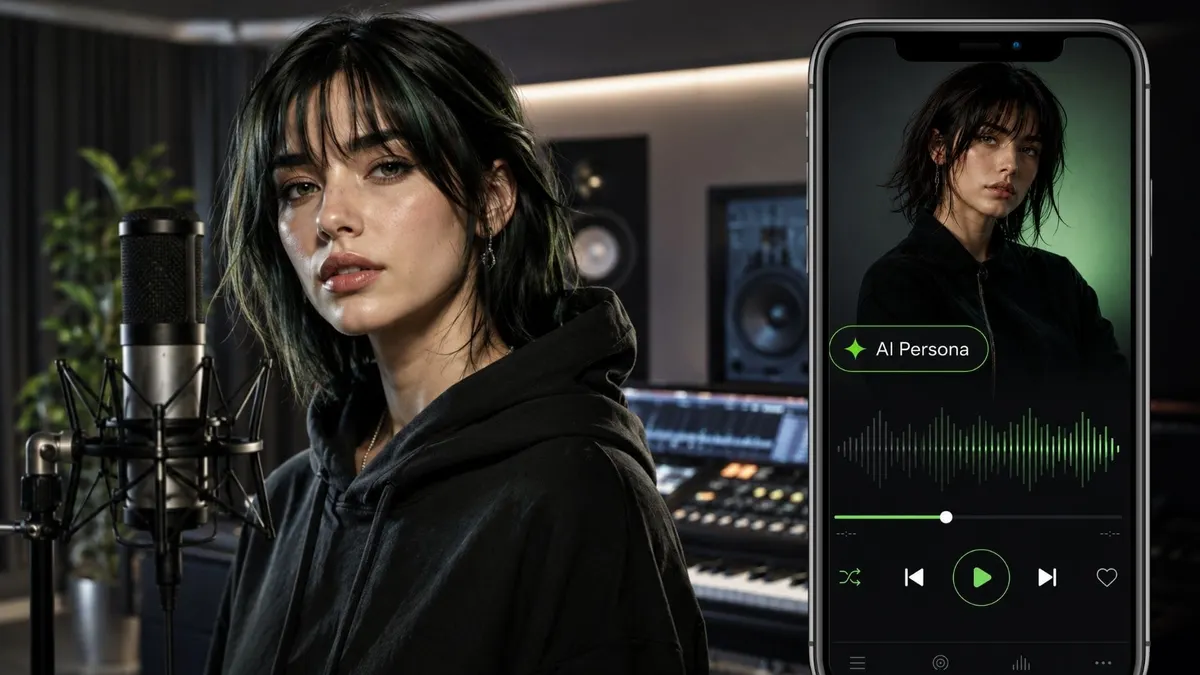
Spotify’s New ‘AI Persona’ Badge Will Label AI Artists and Limit Recommendations
Spotify is adding a new label to artist profiles built around AI-generated identities and changing how their music gets discovered.
The streaming platform is introducing an AI Persona badge for artist profiles whose public identity may be AI-generated and does not represent a real person.
More importantly, Spotify will keep music from those profiles out of its editorial and algorithmic recommendations by default.
The badge is expected to appear starting in mid-September 2026, according to Spotify’s August 11 announcement. It will show up across several parts of the mobile app, including artist profiles, Search and playlist track rows.
Spotify says the move is meant to give listeners a clearer idea of who, or what, is behind the music they hear.
It is also part of a much bigger industry shift. Streaming services, labels and trade groups are all trying to figure out how to handle a flood of AI-generated music, synthetic artist identities, voice clones and automated uploads without treating every use of AI as the same thing.
Spotify’s answer is to separate two questions: Is the artist identity real? And was AI involved in making the music?
The new badge addresses the first.
What Spotify’s AI Persona Badge Is
Spotify’s AI Persona badge is designed to identify artist profiles whose public-facing identity is AI-generated rather than representing an actual person.
That includes the name, image, and identity presented to listeners through the artist profile.
Spotify says the label is intended to make clear that an artist’s identity “may be AI-generated and does not represent a real person.”
That distinction matters because an AI Persona is not necessarily the same thing as an AI-generated song.
A fictional digital singer could have an AI-generated face and identity while working with human songwriters, producers, and musicians. At the same time, a real artist could use AI tools during production without becoming an AI Persona.
Spotify is treating those as two separate issues.
| Example | Badge? | Why? |
|---|---|---|
| Fictional singer, human-made music | Yes | The identity is synthetic |
| Real singer, AI-assisted mastering | No | The identity represents a real person |
| Virtual artist, AI-generated music | Yes | The identity is synthetic |
| Real artist using AI vocals or effects | No | AI use alone doesn’t trigger the badge |
Why Spotify Is Introducing the Badge
Generative AI has made it much easier to create not only music, but entire artist identities.
A synthetic artist can now have a realistic face, biography, cover art, social media presence, and catalog without an actual performer existing behind the profile.
That creates a problem when listeners cannot tell the difference.
Spotify said listeners had made it clear they did not like seeing an artist profile that appeared human, only to later discover the persona was AI-generated.
The company is responding by making that information visible upfront.
Spotify’s badge doesn't try to solve all those problems at once.
Instead, it addresses one of the clearest: if the artist presented to listeners is synthetic, Spotify wants to disclose that.
How an Artist Receives the Badge
- Artist self-disclosure: Artists and their teams can identify the profile as an AI Persona through Spotify for Artists. This is important because not every synthetic artist is trying to deceive listeners. Check out this article from a few years ago about the rise of virtual influencers.
- Spotify review: Human reviewers and investigative AI tools can identify potentially synthetic profiles.
- Listener reports: Spotify plans to let users report suspected AI Persona profiles in the coming months.
- Notification and appeal: If Spotify applies the badge, the affected artist will be notified and can disclose or appeal.
Where Listeners Will See the AI Persona Badge
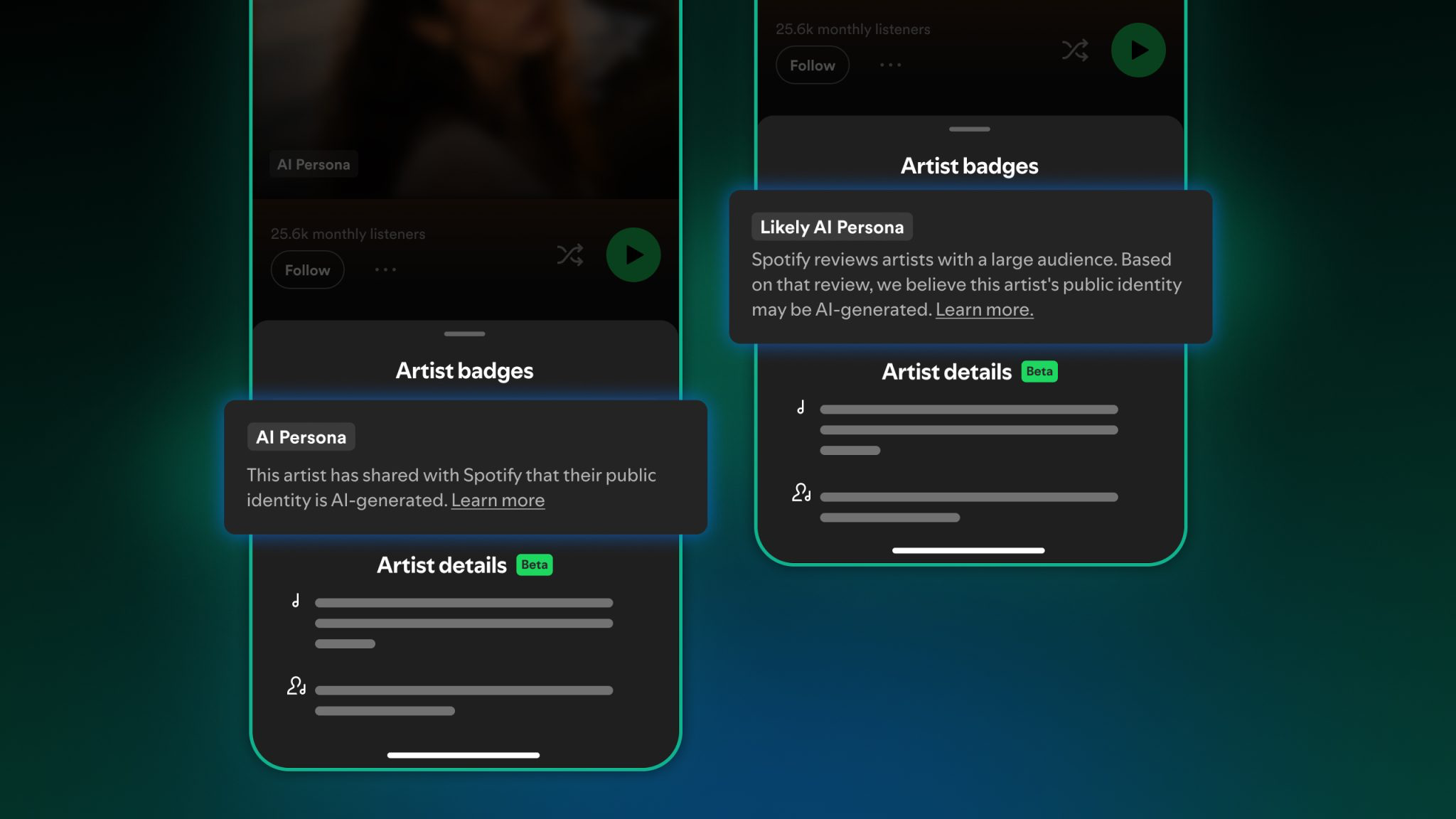
The badge is expected to appear in:
- Artist profile banners
- Artist About sections
- Search results
- Playlist track rows
The initial rollout will be limited to Spotify's mobile app.
What changes / What doesn't
After many complaints, Spotify will not include music released by profiles carrying the AI Persona badge in its editorial or algorithmic recommendations by default.
Check out this article to see why curators are resisting the rise of AI music.
What changes
- AI Persona music will be excluded from editorial programming by default.
- It will not be automatically surfaced through algorithmic recommendations.
- AI-native projects may need to rely more heavily on search, social media, advertising, and existing fan communities.
What doesn’t change
- The music remains available on Spotify.
- Listeners can search for and play it directly.
- Listeners can follow AI Persona profiles.
- Following the artist may allow it to become relevant to that listener’s personalized experience.
In other words, the company is drawing a line between allowing AI Persona projects to exist and actively promoting them through its discovery systems.
Spotify Is Building a Broader AI Transparency System
The AI Persona badge is only one part of Spotify’s broader approach to AI.
The platform has also been developing AI Credits, which disclose AI use in recordings when labels or distributors supply that information.
Spotify has pointed to SongDNA and expanded music credits as additional ways listeners can learn more about who contributed to a track and how it was created.
The company has also introduced an artist verification badge.
At launch, Spotify said profiles that primarily appear to represent AI-generated or AI-persona artists are not eligible for that verification.
Learn how to get verified on Spotify here.
| Spotify feature | What it tells listeners |
|---|---|
| AI Persona badge | Whether the artist identity is synthetic |
| AI Credits | Whether AI was involved in making the recording |
| SongDNA | Who contributed to the track and how it was created |
| Artist verification | Whether the profile qualifies for Spotify’s verification system |
The goal appears to be moving away from one vague “AI music” category and toward more specific information about what AI was actually used for.
What the Policy Means for Artists and Labels
| Group | Likely impact |
|---|---|
| Human artists | Less synthetic competition in recommendation systems |
| AI-native projects | Still available, but more reliant on intentional discovery |
| Labels and distributors | Need accurate identity and AI-use metadata |
| Listeners | Get clearer identity disclosures before listening |
Why Streaming Fraud Is Part of the AI Music Debate
AI-generated music and streaming fraud are not the same thing, but the two issues increasingly overlap.
Generative tools make it possible to create enormous catalogs quickly and cheaply.
That can become a problem when automated music creation is combined with fake streams or other forms of royalty manipulation.
Spotify said in September 2025 that it had removed more than 75 million “spammy” tracks over the previous year as it tightened rules around impersonation and AI-enabled fraud.
That does not mean every AI artist is fraudulent.
Legitimate virtual performers, experimental projects, and artists use generative technology creatively.
The problem is scale.
When music, artwork, and artist identities can all be generated automatically, bad actors can operate at a level that would have been far more expensive a few years ago.
Spotify’s AI Persona badge will not stop fraudulent streaming on its own.
But keeping synthetic artist identities out of recommendations by default removes one avenue through which those profiles might otherwise gain additional exposure.
Conclusion
Spotify’s policy draws a clear line: synthetic artists can remain on the platform, but Spotify will label their identities and limit their automatic reach.
For artists, the update provides much-needed distinction, and for listeners it provides more transparency.
By separating who an artist is from how their music was created, the company is establishing a more nuanced model for AI transparency, one other streaming platforms may eventually follow.
FAQ
What is Spotify’s AI Persona badge?
Spotify’s AI badge identifies artist profiles whose public identity is AI-generated or does not represent a real person. It applies to the artist persona, not necessarily the way the music was created.
Is Spotify banning AI artists?
No. AI Persona music can remain on Spotify, and listeners can search for and play it. However, Spotify will keep it out of editorial and algorithmic recommendations by default.
Does an AI Persona badge mean the music was made by AI?
No. The badge refers to the artist’s identity. A synthetic artist may work with human musicians, while a real human artist can use AI production tools without becoming an AI Persona.
When will Spotify’s AI Persona badge appear?
According to Spotify’s August 11, 2026 announcement, the badge is expected to appear starting in mid-September 2026 across artist profiles, Search, and playlist track rows on mobile.
Looking to Promote Your Music?
Try our Spotify Playlist Pitching and TikTok Music Promotion services.